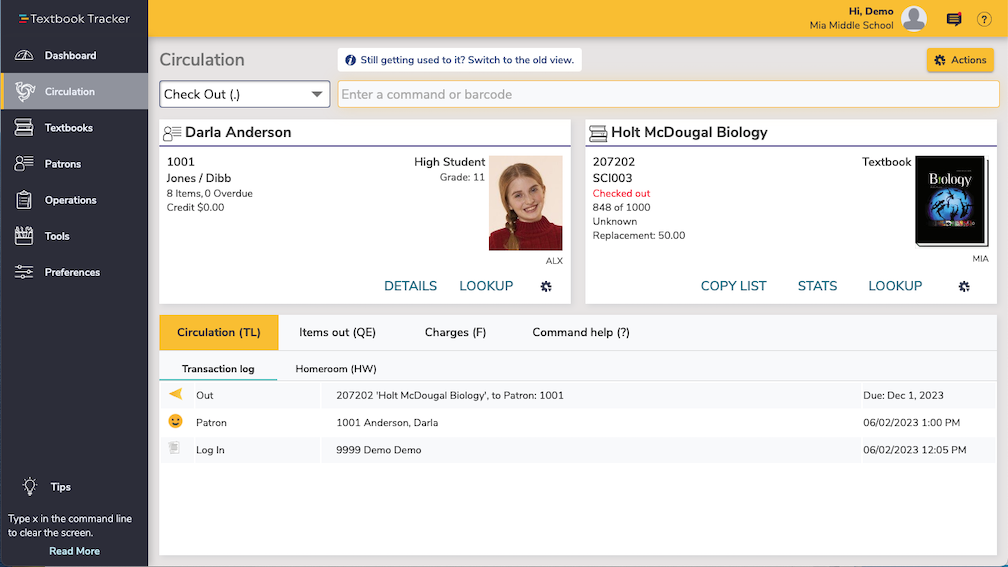
Circulation is the Librarian’s primary module, used to perform general library activities like checking books in and out, placing holds and reservations, processing fees, fines, payments, etc.
To log in directly, add /circulation to the end of your Alexandria URL.
Circulation Video Playlist
Related Tips
Contact Support
Circulation FAQs
January 2025: Due to some updates, we recommend clearing your cache to improve Circulation function.
Navigation
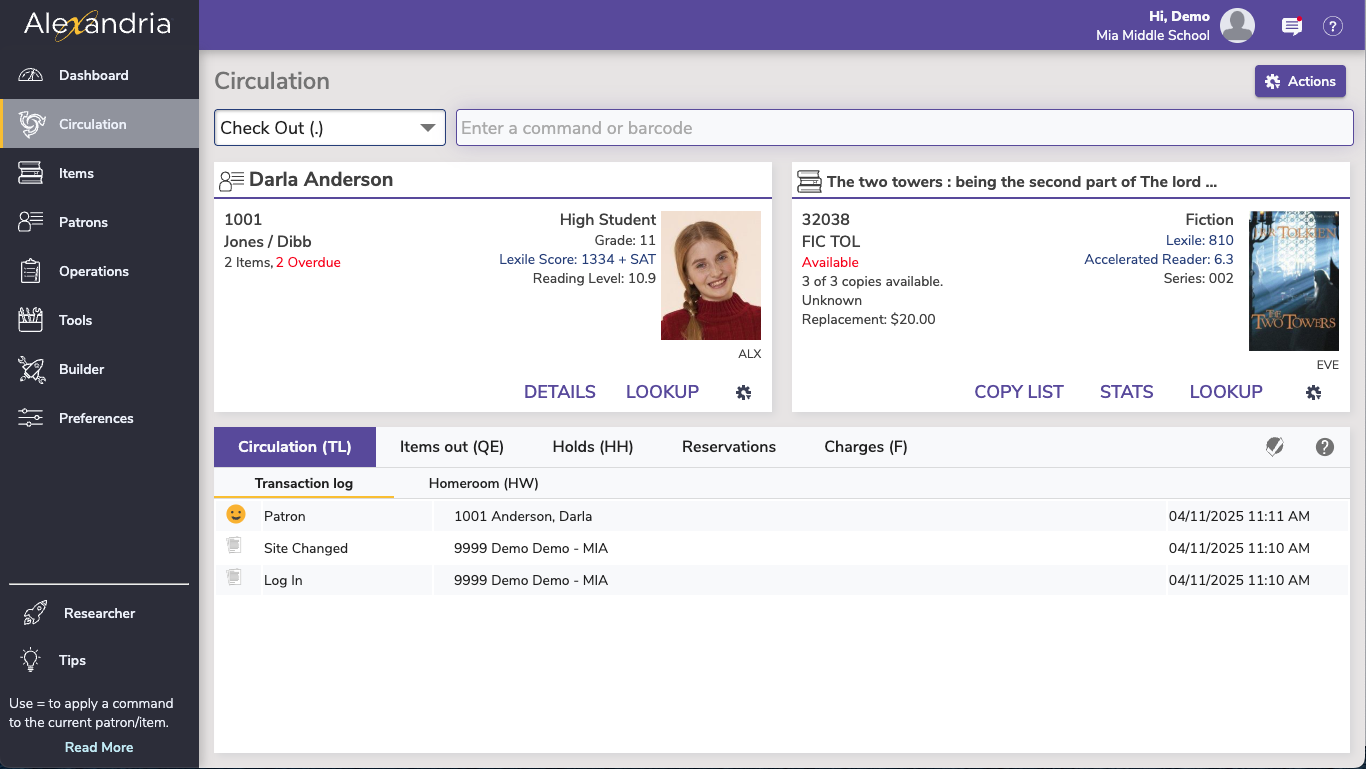
Circulation includes a few important and distinct areas:
The Actions dropdown menu contains specialized circulation functions such as the Advanced Bookings and Process Pending Bookings commands.
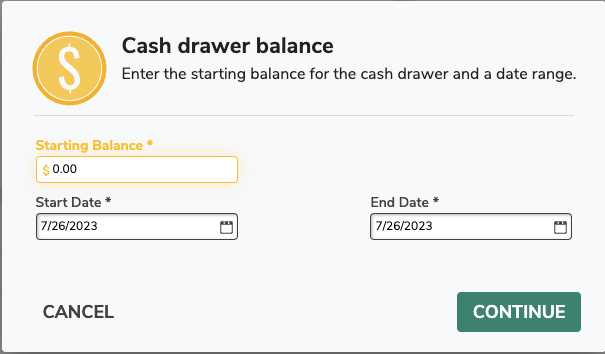
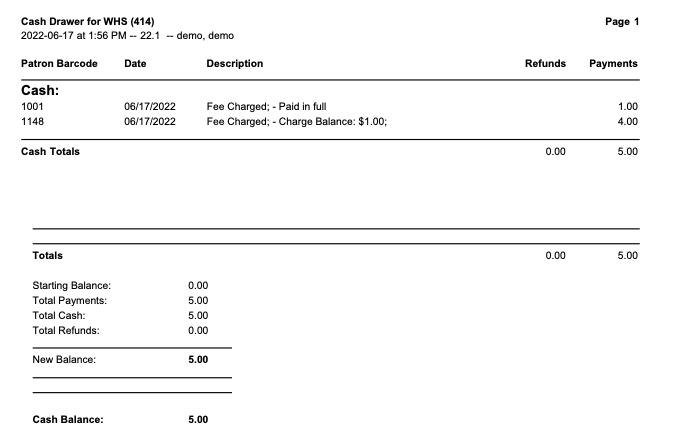
Cash Drawer Balance. Enter the cash drawer Starting Balance, Start Date, End Date, and click Continue. The report totals your payments and refunds, and includes patron barcodes, dates and descriptions of charges, total refunds and/or payments, the initial drawer balance, and the new balance.
Advanced Bookings.This will open the Advanced Bookings window, which allows you to process reservations that begin on or between two selected dates.
Process Pending Bookings. This performs the Process Pending Bookings command, which checks to see if any of the unavailable items have recently become available. If they have, they’re automatically assigned to the requesting patron.
Command Line
The command line, located at the top-center of Circulation, is where you enter circulation commands or barcode numbers for patrons and items. If you enter only a barcode, the current Circulation Mode (shown to the left of the command line) will determine what action is performed. By default, the command line assumes that text input is a circulation command first and a patron/item barcode second. You should follow commands with a space before a barcode, e.g. b 12092.
Override Date. An operator-provided Override Date can appear immediately after the Command Line. The function of an override date depends on the current Circulation Mode.
Circulation Modes
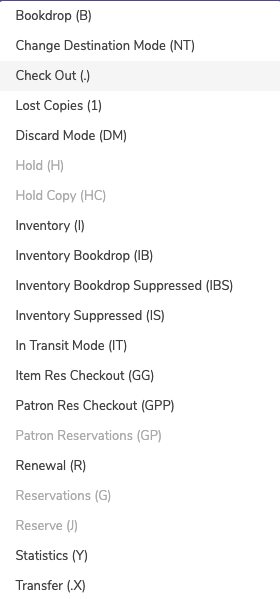
Select a Circulation Mode from the dropdown menu located to the left of the Command Line. The Circulation Mode field indicates which function will be implemented when patron/item barcodes are typed or scanned. Frequently used modes are Bookdrop (B), Check Out (.), Hold (H), and Renewal (R).
To check out, hold, or reserve an item, you need to have a Current Patron pulled up in Circulation.
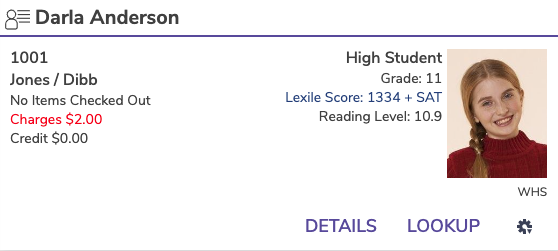
The Current Patron pane shows important patron information such as barcode, name, checked out items, charges, and credits, as well as their grade, Lexile score, and reading level (when set in Preferences). This data can differ depending if you are looking at this patron in Alexandria or Textbook Tracker.
Searching for patrons is restricted by the sites you (as an operator) have access to
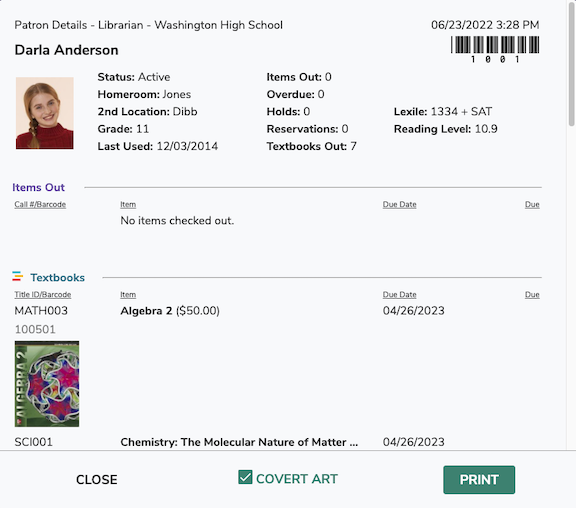
Details: View and email or print the current patron’s account details, including currently loaned items, holds, reservations, fees and other charges, and general information. You can choose whether or not to include cover art when viewing, emailing, and printing patron details.
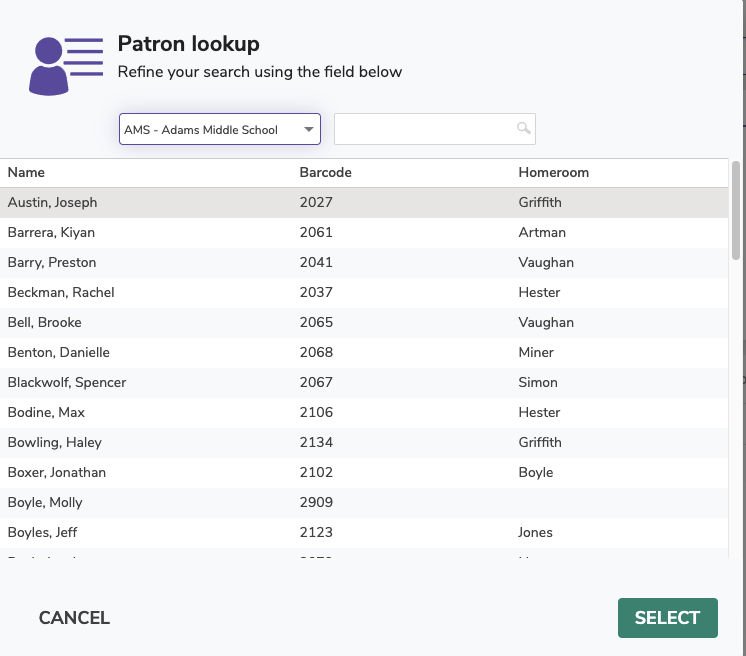
Lookup: Opens the Patron Lookup dialog, allowing you to search your database for patron records; performs the same action as using the “L” command.
Notes. Available when the current patron has associated notes. Notes are provided for patrons in the Notes tabs of Patrons Management. When clicked you are also able to add notes directly to the resulting Patron Notes dialog.
Reserves. Provides a list of the current patron’s reserves; you can remove some or all reserves from the resulting Patron Reserves dialog.
History. Runs an individual Patron History report, which shows recent payments, credits, renewals, lost items, refunds, Lexile history, and returned items. The PDF will automatically download. You can also run this report by clicking Show History in the Actions menu of Patrons Management.
Patron Details will show relevant details for Library or Textbook data, depending on which Circulation window you access it from. To view Textbook data from Librarian or vice versa, adjust your Circulation Preferences.
Circulation’s Patron Details is interactive! Say you want to renew an item or forgive a charge for the patron whose Details you’re viewing. Simply click on that section’s heading (i.e. “Items Out” or “Charge Summary”) to be taken to the right place in Circulation.
Use the Circulation Command D to print or email transaction details for patrons.
Current Item
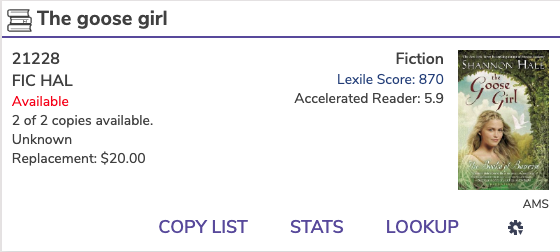
The Current Item pane consists of two areas: The white area contains the copy, barcode, policy, call number, status, picture, and a short summary of available title copies. At the bottom, access the Copy List, Stats, item Lookup, and the actions menu.
Copy List
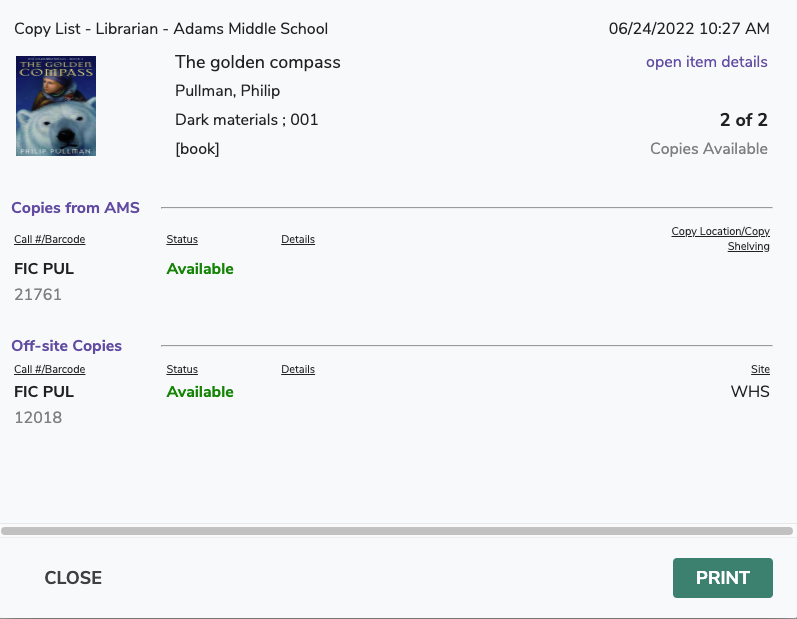
The Copy List shows how many copies are available, the holds queue, and lists each copy’s site, location, status, and details. It can be viewed or printed, and you can use the Q= command for quick access.
If there are more than 1000 copies, the Copy List will only show copies from the current site.
Several parts of the Copy List are clickable:
Author’s name. Performs an automatic item lookup by author.
Open item details: Pulls up that title’s Item Details.
Patron names: Makes that patron current.
Copy call numbers and barcodes: Makes that copy current.
Copy Stats
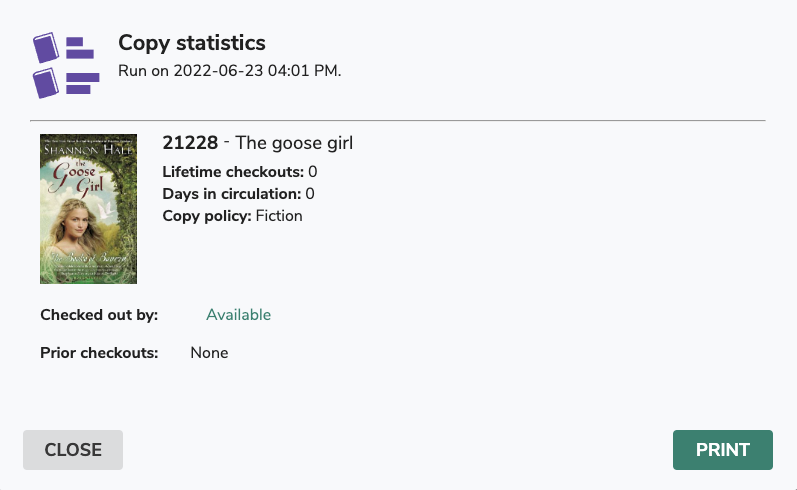
See the copy’s checkout count, last use date, previous checkouts, and more with Copy Stats.
Lookup
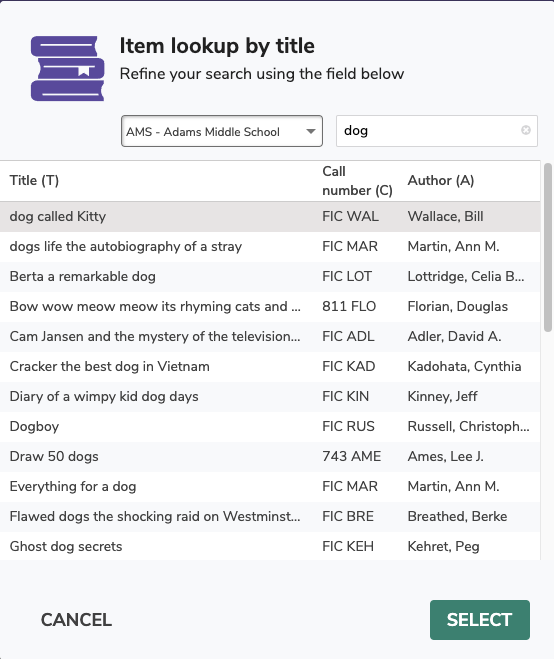
Enter your search term and then scroll through your results below. In a Centralized Catalog, select the site you want to search from the dropdown menu in the bottom left corner of the dialog.
You can also start a “begins with” search from the command line using an asterisk in the T command. For example, you would type “har*” if you were looking for Harry Potter.
Actions Menu
Details. Contains information about the item, including reviews, summary, links, genres, subjects, Study Programs, awards, and publisher information. It can be viewed, printed, or emailed. While viewing Item Details in Circulation, you can click on open copy list to pull up the Copy List or on the review stars to open Reviews Management. Use the QI command for quick access.
Notes. Add a new note or view existing notes for the current copy. Copy Notes and Alert notes can be entered here or in Items > Copy Records.
Reserves. Shows if any Patron has placed a reserve on the copy.
Show Map. If the current copy’s call number falls within the range of a corresponding map (created in Maps Management), selecting Show Map will display the the map, detailing where the copy is located in your library. These maps can be conveniently printed from your browser and handed to interested patrons. If the current copy lacks a call number (or there is no map with an associated call number range), Show Map is disabled.
Vendors. This selection opens a secondary menu containing a list of Alexandria third-party partners that, when selected, link to their respective websites. Individual vendors can be disabled in Services Preferences.
Textbook Tracker
The Textbook Tracker Circulation interface works very much the same as Alexandria. Textbook Tracker does not have Reservations, Holds, or Advanced Bookings. You’ll see some other slight differences, such as the inclusion of the Copy Tag in the Current Item pane.
What's the best way to automate my patron overdue or hold notices?
How do you want notice to be sent? If you’d like the program to do most of the work for you, try Automatic Email Notifications. Go to Preferences > Circulation. In the Circulation Settings tab, click the Enable automatic email notifications checkbox. This feature automatically sends email notices to the patron’s email address for in-stock holds, overdue fees, and a number of other things. Read more about it in Circulation Settings.
For those of you who want greater control over your notices – such as when they go out and to whom – use scheduled notice reports. For example, you could set up an Overdue Items and Unpaid Charges Notice report for each grade or homeroom and schedule it to email the teacher every month so they can help remind students.
Go to Operations > Notices, add a new notice, and choose the Circulation category.
Test out a few of the report notices to see which ones work best for your situation. When you’ve found one, click Create at the bottom right.
Build your report in the Selections and Options tabs.
In the Overview tab, schedule the report to run at a specific frequency and time.
You can also enable email notifications and specify to whom the notices will be sent. Separate email addresses with a comma.
And if you find it meets your needs, you can even use both methods at the same time!
How do you access the X command?
To run the ‘X’ command just enter ‘x’ in the command line in Circulation. You can learn more here.
How do I remove old Homerooms from my Homeroom list?
Once there are no patrons listed in a homeroom anymore, the homeroom is removed. So, updating the homerooms manually, via import, or through Authority Control will remove any homerooms with no patrons. Contact Support for additional assistance.
How do I forgive charges?
To forgive a charge for an individual patron, use Circulation.
Make the patron current and go to the Charges tab.
Select the charge (or by holding <shift> or <command> you can select more than one).
Click Make Payment. (Or Forgive Charge.)
Click the box to Forgive remaining balance, and click Process.
To forgive charges in batches, use the Forgive Charges utility.
Go to Operations > Utilities > Patrons > Forgive Charges.
Use the Selections tab to choose who you are forgiving the charges for.
Use the Options tab for what type of charges to forgive, or in a specific date range.
Click Run.
How can I easily change the copy location or copy shelving?
The easiest way is by using the Set All Copy Locations or CH command in Circulation. This is much quicker than going into each item to change copy locations. Make sure to clear the command line when you’re done! You can also run the Copies Information Report to help view and sort your items.
How are lost or discarded items handled in Alexandria?